Sign Up

If you have bought a backlink before, you know the routine. You sort by Domain Rating. You sort by traffic. You pick the biggest numbers you can afford. The idea is simple: higher numbers mean a better site, and the best sites must be the ones people buy most.
We wanted to check if that is true. So we looked at our own data. We took the last 1,000 websites that got an order on Links.me — every site with at least one published order — and compared each site's Ahrefs Domain Rating and traffic with how many orders it actually got.
The short answer: no matter the Domain Rating, sites got about the same number of orders. A DR 5 blog and a DR 80 site were almost equal. The link between DR and orders was just 0.08 — basically zero.
Domain Rating barely changes anything
We split the sites into DR groups and counted the average orders per site in each group. If a higher DR brought more orders, the bars below would go up from left to right. They don't.
Average orders per site, by Domain Rating band
Taller bar = more orders per site. Number under each bar = sites in that group.
The busiest group is not the strongest one. Sites with DR 20–29 got the most orders per site (2.29) — more than the DR 70+ group (1.98). A big DR simply does not bring more sales.
The most popular sites sit in the middle of the DR scale — not at the top.
This is the opposite of "buy the highest DR you can." Most orders went to mid-range sites (DR 20–40). They are cheap enough to try, solid enough to trust, and there are lots of them — so buyers keep coming back.
Traffic helps a little — but not much
Traffic does a bit better than DR: orders go up slightly as traffic grows. But only slightly. Going from a site with no traffic to one with 100K+ visits a month barely changes the result, and the link is still only 0.08.
Average orders per site, by organic traffic band
Ahrefs monthly traffic. "0" = sites with no measured traffic.
A small, steady rise — from 1.64 orders per site with no traffic to 2.00 at 100K+. Real, but small: high-traffic sites get a little more demand, not a lot.
Here is the part that surprised us most: 260 of the 1,000 sites — more than a quarter — have no measured traffic in Ahrefs, and they still got orders. Whatever buyers care about, a clean traffic chart is clearly not required.
Two sites, opposite numbers, same demand
One example makes it clear. A DR 21 blog with no traffic got 13 orders. A DR 92 site — near the top of the scale — got one. This isn't a rare exception; it is how the whole dataset looks.
The spread says the same thing. Most sites got just one order (the median across all 1,000). A few got many — but those few are spread all over the DR range, not stacked at the top. Demand is shared across many ordinary, well-matched sites.
All 1,000 sites in one chart
Put every site on one chart — Domain Rating along the bottom, orders up the side — and you can see it. There is no line going up to the right. The busy band stays low and flat, and it is thickest in the middle, not on the right.
Every site: Domain Rating vs. orders received
1,000 sites · dot size = traffic
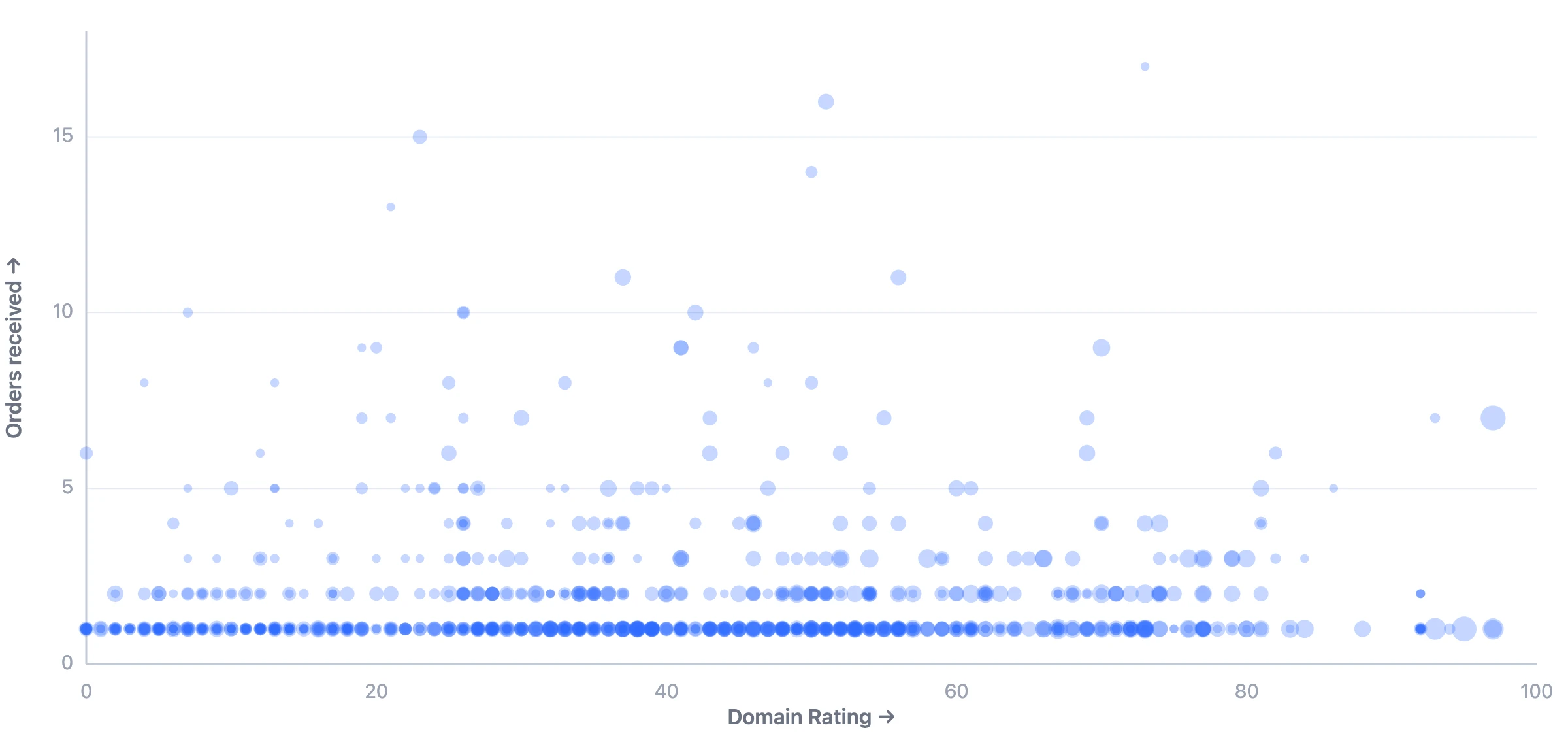
If DR drove sales, the dots would climb to the right. Instead they stay flat — high-DR sites are just as likely to have one or two orders as low-DR ones.
So what actually drives demand?
If not the raw numbers, then what? We think buyers pick by relevance first. Topic, country, language, price, and how the site looks to a real person matter more than a two-digit score. DR and traffic are just a quick check — a minimum to pass, not the goal.
- Authority is a filter, not a driver. Across DR and traffic, orders per site stay near 1.4–2.3, with no real trend up.
- The sweet spot is the middle. DR 20–40 sites get the most demand — cheap, trusted, and plentiful.
- Traffic helps a little. Orders rise slightly with traffic (1.64 → 2.00), but the effect is small.
- Numbers don't decide. Over a quarter of sites that sold have no measured traffic — relevance and price win.
None of this means DR is useless. It just means DR is a basic check, not a score of value. If you sell links, you don't need a perfect profile — you need clear topics and fair prices. If you buy links, always picking the biggest number means you miss better-matched, better-priced sites.
How to pick a site on Links.me: a 5-point check
If DR isn't the thing to chase, here is the order to follow instead:
- Start with relevance. Does the site really cover your topic? A contextual link on a fitting page beats a higher-DR link on an unrelated one.
- Match country and language. A link in your market and language means more for local searches — see link building for local SEO.
- Use DR and traffic as a minimum, not a target. Set a sensible floor, then stop chasing bigger numbers — authority is just a check.
- Compare price to value, not to DR. A fitting DR 30 site at a fair price usually beats an off-topic DR 70 one that costs 3× more.
- Look at the site like a reader. Real articles, real standards, no link-farm feel — the signs of white-hat link building.
FAQ
Does Domain Rating still matter at all?
Yes — as a minimum, not a goal. DR is a fast way to skip dead or spammy domains. Once a site passes a sensible floor, a higher number adds little: in our data, orders per site hardly changed from DR 20 to DR 80.
Should I ignore organic traffic?
No, but don't over-weight it. Traffic gives a small boost in demand (1.64 → 2.00 orders per site from zero to 100K+), and over a quarter of sites that sold had no measured traffic. Treat it as one signal, not the deciding one.
What DR range should I aim for?
The busiest group in our marketplace was DR 20–40: cheap, trusted and plentiful. That is a good target for most campaigns — add strong topic relevance and you cover the two things that matter. If you're planning volume, see how many backlinks you need to rank.
How did you calculate the correlation?
We used Spearman's rank correlation between each site's number (DR or traffic) and its order count. A value near 0 means almost no link; both DR and traffic came out around 0.08.
published. We took the 1,000 domains with the most recent published orders, then added each one's Ahrefs Domain Rating and traffic. "Correlation" is Spearman's rank correlation between a site's number and its order count — a value near 0 means almost no link. We used grouped data only; no single buyer, seller, or price is shown. ChatGPT
 Perplexity
 Claude
 Google AI Mode
 Grok
Grok