Sign Up


Senior teams value predictable actions. They want steps that improve visibility without risky tactics or waste. Context-based references work well because they influence both trust and topical relevance.
What Are Contextual Backlinks?
A contextual backlink is a link inserted into the core text of a page where the surrounding content directly supports the subject of your linked page. This position gives search engines semantic guidance and shows that the reference serves a real purpose. Short placement in a relevant paragraph is often stronger than dozens of unrelated mentions elsewhere.
Sidebar and footer links behave differently. Their context is weak, and the meaning around them rarely clarifies why the page deserves attention. When a link sits inside a clear explanation, the search engine can connect your topic to the right queries. That clarity improves how your content is ranked and understood.
By the way, many teams still ask what are contextual backlinks, which shows how often companies underestimate the role of relevance.
Why Contextual Backlinks Matter for Rankings
Businesses need outcomes they can measure. Contextual references often increase keyword visibility, especially in competitive niches. They also strengthen topical clusters, making your domain appear more coherent and reliable.
Search engines evaluate placement, tone, and intent. A link embedded in a paragraph demonstrates purpose, not manipulation. That’s why these placements accelerate indexing. Crawlers interpret the surrounding text and connect your page to the right semantic fields.
Over time, these signals compound. Authority spreads across the domain, not just one URL. Companies that invest in relevance see more stable ranking movement.
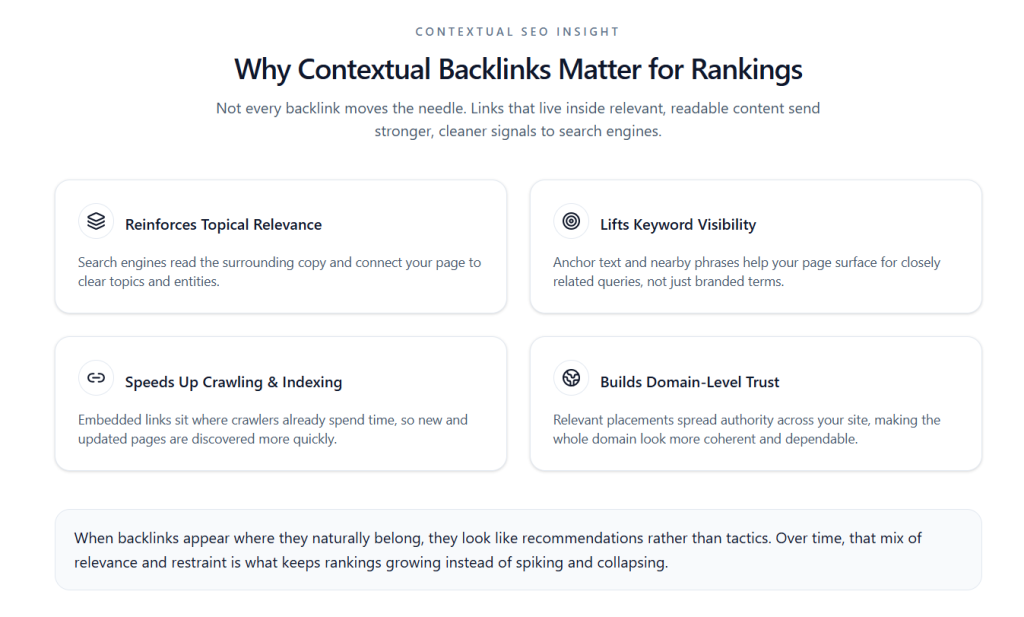
The idea behind contextual backlinks meaningis simple: the link matters because the topic around it matters.
Strategic Blueprint for Building High-Value Contextual Backlinks in 2025
Contextual acquisition requires structure. You need a predictable system that balances quality, pace, and business priorities. Below is a practical framework that senior teams can apply immediately.
Working Techniques That Consistently Deliver Results
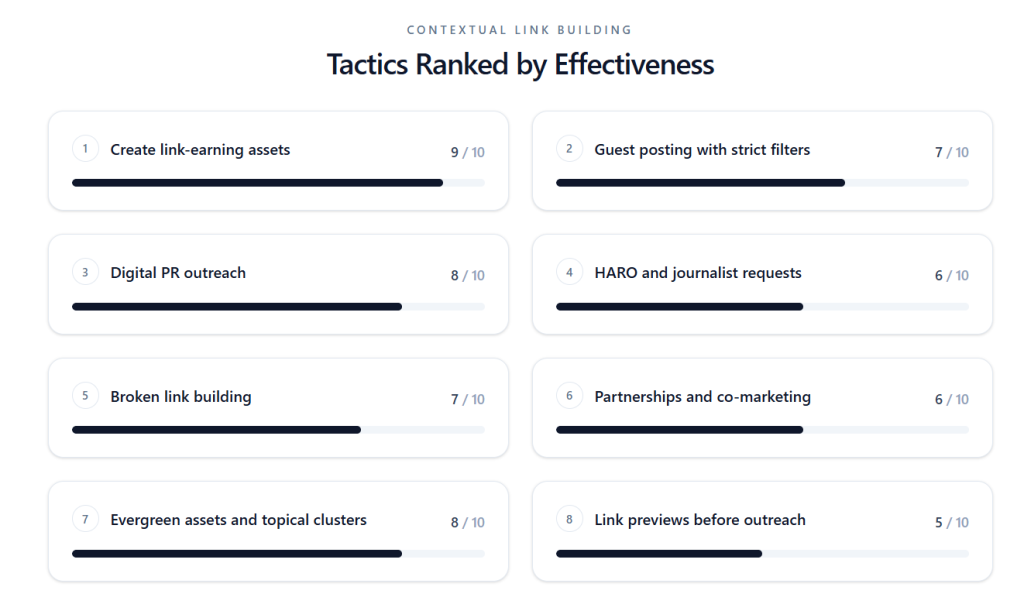
- Create link-earning assets. Strong assets attract natural references. Use industry data, comparison research, templates, and frameworks. These formats deliver the value that authors want to cite. Publishing them consistently keeps your pipeline active.
- Guest posting with strict filters. Choose sites with real traffic, visible indexing, and strong relevance. Content should be direct and practical. Add your link only where it strengthens the explanation. This is how contextual link building avoids looking artificial.
- Digital PR outreach. Media outlets value numbers and insights. Share data that helps journalists explain trends or illustrate market changes. Editorial mentions carry high trust and often deliver long-lasting benefits.
- HARO and journalist requests. Provide short, specific answers. Add one insight or a small data point to increase your chances of inclusion. A clean, concise response stands out among vague submissions.
- Broken link building. Identify outdated references on competitor pages. Offer a relevant replacement and explain why it fits. When the substitution improves the page, site owners update it quickly.
- Partnerships and co-marketing. Joint webinars, reports, and interviews naturally integrate several contextual references. Collaboration also gives you access to new audiences without additional outreach effort.
- Evergreen assets and topical clusters. Long-lasting content keeps earning mentions. Link clusters around a clear theme improve how search engines interpret your expertise. This structured approach helps you decide how to create contextual backlinks that do more than fill quotas.
- Link previews before outreach. Start with a snapshot: one insight, chart, or quote. Writers respond more often when the value is visible upfront.
One practical starting point is understanding how to get contextual backlinks through assets rather than volume-based tactics. And when teams explore deeper, they often look for solid contextual link building strategies that don’t depend on spam or paid placements.
In certain cases, companies target stronger placements like dofollow contextual backlinks, though quality always matters more than the tag alone.
Quality Metrics for Every Contextual Backlink
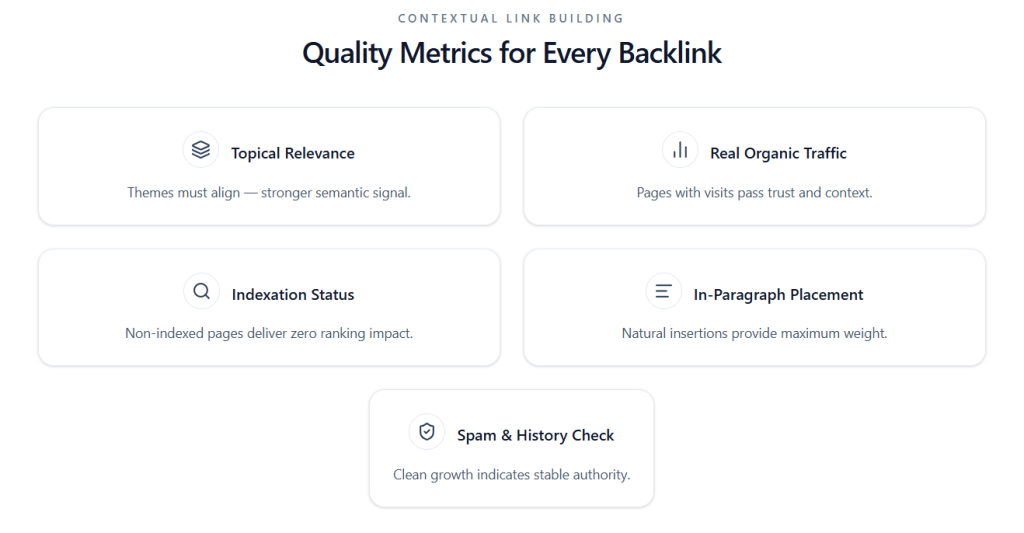
Evaluating quality is essential. Rankings depend on precision, not volume. That is why every link should pass a clear set of checks before you invest effort into earning it.
- The first requirement is topical relevance. If the linking page covers a subject that matches your own, the signal becomes stronger. Search engines see alignment between themes and treat the reference as a meaningful connection.
- Real organic traffic is the second checkpoint. A page that receives visitors can pass trust and context, while a dead page contributes almost nothing. Traffic also shows that the site is active and that crawlers revisit it.
- Indexation matters as well. A link placed on a non-indexed page has no effect. Always check whether the donor URLs appear in search results. This one step saves time and keeps your strategy efficient.
- Next, evaluate placement. A natural insertion inside a paragraph carries far more weight than a forced mention. The structure around it should read smoothly, without signs of manipulation.
- Finally, review the site’s spam indicators and history. Steady organic growth signals reliability. When these elements line up, the backlink contributes real authority. In some rare cases, teams also explore contextual dofollow backlinks, though even then, relevance remains the primary factor.
Mistakes That Harm More Than They Help
Many companies lose momentum because they repeat predictable errors:
- Buying links on irrelevant sites is one of them. These placements rarely match your topic, and Google often ignores them entirely.
- Another frequent issue is anchor misuse. Overloading texts with commercial keywords distorts natural patterns and increases risk. Clean, balanced anchors perform better and remain safer over long periods.
- Then comes misaligned targeting. Some teams point strong links to pages that do not support revenue or lead generation. When links enhance low-value URLs, the business impact disappears.
- Over-optimization also creates problems. Technical patterns, identical structures, and repetitive link placement make your profile look unnatural. Search engines detect these signals quickly.
- Finally, mass outreach without segmentation wastes resources. When every recipient receives the same message, reply rates collapse. A segmented approach takes more time but produces higher-quality contextual placements.
Businesses that fail to understand what is contextual backlinks often fall into these traps. The issue is not execution but the lack of a clear logic behind every step.
Turning Strategy Into Execution
Companies need a reliable process they can repeat:
- Begin by analyzing the competitors that dominate your target keywords. This gives you a benchmark and highlights the content types attracting real citations.
- Identify the pages on your site that deserve links. Prioritize the ones connected to revenue, conversions, or long-term authority. The goal is not to collect links but to strengthen the pages that matter most.
- Create a pipeline of assets. Reports, templates, and tools generate interest and give writers a reason to link. Publishing consistently improves your chances of earning natural mentions.
- Run a structured outreach workflow. Personalize messages, provide value upfront, and show why your material supports the writer’s topic. A brief insight or data point creates trust quickly.
- Maintain ongoing quality control. Every new link should fit your broader structure and reinforce your topical positioning. Skipping this step leads to wasted effort and inconsistencies in authority.
Some marketers refer to this evaluation process as a backlink contextual assessment because it focuses on how well each placement reflects its surrounding narrative. The term may sound technical, but the principle is simple: links must appear where they genuinely make sense.Contextual backlinks outperform generic link types because they combine relevance, authority, and strong user intent signals. This makes them one of the highest-ROI actions for any business aiming to strengthen visibility and organic acquisition. When companies invest in context, they gain stable, predictable growth.
 ChatGPT
 Perplexity
 Claude
 Google AI Mode
 Grok
Grok