Sign Up


This article focuses on the practical side: when guest blogging delivers value, why it outperforms conventional link buying, and how companies can secure placements on credible blogs. You’ll also see where the method fails, what prevents ROI, and how to evaluate opportunities before committing budget.
What Guest Blogging Means in Practical SEO
Guest blogging in SEO is straightforward: a company contributes a useful article to a relevant publication, and that article includes a contextual link that supports a priority page. It’s not a directory, not a blind insertion, and not a disguised advertisement. Guest posting in SEO acts as a structured editorial placement inside content that real audiences read. The company essentially buys controlled exposure inside a native-format article, where a link fits naturally and strengthens the surrounding narrative.
Why Guest Blogging Outperforms Standard Link Building and When It Works Best
Traditional link building focuses on convenience rather than relevance. Quick inserts, inflated domains, and synthetic networks rarely move rankings because they sit on pages that receive no traffic and offer no editorial value. A link exists, but it changes nothing. Guest blogging approaches the problem differently and does so in a way that aligns with how modern engines evaluate trust and context.
Where Traditional Link Building Fails
- Links often land on pages with no organic visibility.
- Many placements lack topical relevance or editorial structure.
- Networks and resellers inflate domain metrics without real readership.
- Inserted links rarely generate clicks or engagement.
- Quantity increases, but the profile gains no meaningful signals.
Why Guest Blogging Performs Better
- The link sits inside a full article with a clear topic match.
- The page has intent, a readable structure, and relevance to your audience.
- Content alignment helps engines interpret the link with higher accuracy.
- Real readers create engagement patterns that standard inserts never produce.
- Trust accumulates gradually, which strengthens commercial landing pages.
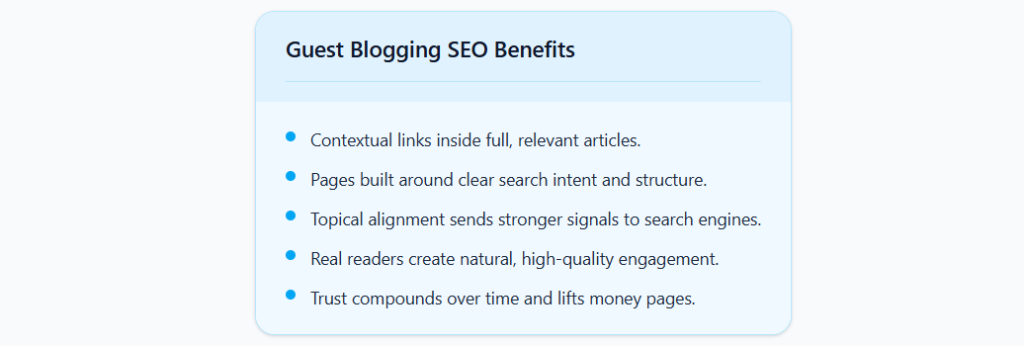
The benefits of guest blogging in SEO become most visible in B2B, SaaS, consulting, and fintech — industries where authority matters more than link volume.
Realistic Ways to Publish on High-Traffic, High-Authority Blogs
Finding good blogs is not difficult; filtering them correctly is the real job. Many sites look strong on paper but fail the moment you examine their traffic per article, topic consistency, or publishing standards. That’s why an SEO guest post should never be purchased blindly. You start by defining which blogs are suitable for your business.
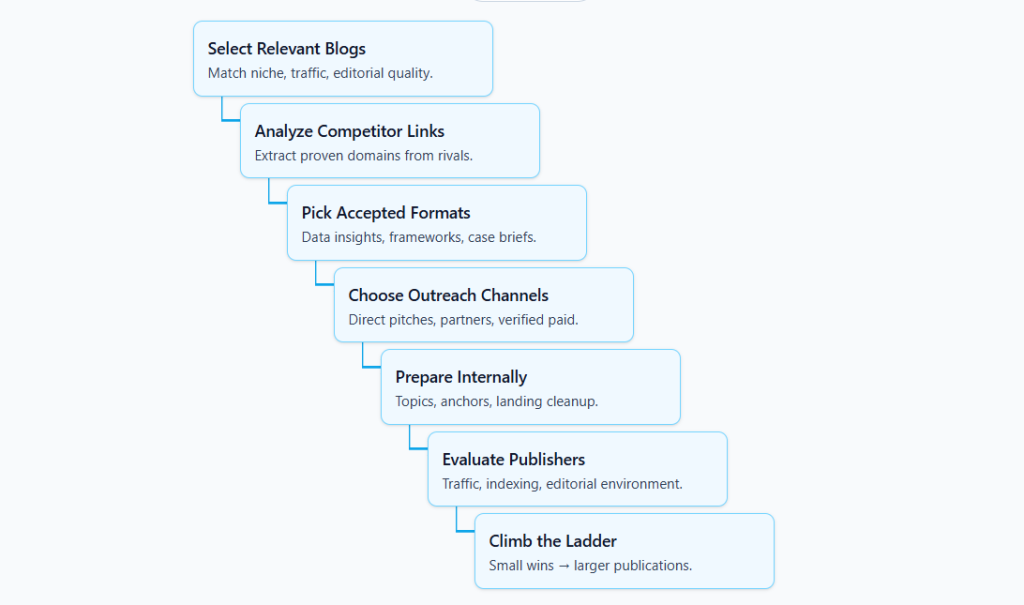
Selecting the Right Blogs
Look at relevance first. A site with real thematic alignment will outperform a higher-metric domain with generic content. Scan recent articles, their traffic, and how often posts gain impressions beyond brand-related searches. You want blogs with stable visibility and editors who maintain consistent quality. DR is a secondary signal; organic performance at the article level is the primary one.

Competitor-Based Shortlisting
Reverse engineering works well here. Export the backlink profiles of your closest competitors and filter only editorial links. Patterns emerge: topics, formats, domains, publication frequency. Those domains form your initial shortlist. This method is also the safest way to discover where an SEO guest posting workflow will deliver measurable results, because you already know similar businesses get traction there.
Formats Editors Accept More Easily
Editors rarely need another generic article. They prefer data-backed insights, clean frameworks, and short case studies. A guest post SEO placement is easier to approve when the article demonstrates actual expertise, provides something concrete, and doesn’t feel promotional. Tactical explainers, market observations, and lessons learned from internal projects are consistently strong formats.
Channels for Getting Published
Direct editorial outreach still works. Send customized messages that reference real posts and offer a topic that fits the publication’s structure. Partnerships work even better: vendors, associations, ecosystem partners, and SaaS integrations often welcome expert commentary. Paid placements can be reasonable, but only when the blog has verified organic traffic and real readership. Anything else risks turning into low-quality guest posts SEO inventory rather than trusted publications.
Internal Preparation Before Publishing
Companies that succeed treat this as a process. They prepare topic maps, align messaging, and clean the landing pages they plan to link. They also formalize anchor-text rules to avoid footprint issues. A team that knows exactly what each guest posting SEO article must support moves faster and wastes less budget. Internal clarity is mandatory before external negotiations begin.
Evaluating Offers from Agencies and Platforms
Transparent publishers can show traffic numbers, indexing history, and examples of previously published branded content. If they can’t, skip immediately. Check URL structure: a subdomain or isolated “guest” silo usually dilutes authority. A clean editorial environment is what turns an SEO guest blogging investment into meaningful results instead of another cost.
The Ladder Approach to Bigger Publications
Start with smaller but credible blogs. Use those publications as proof when approaching larger sites. This approach, compounding over time, beats any attempt to go “big” from the start. As you advance, each guest posting for SEO placement becomes easier because editors recognize prior references. That recognition is a practical advantage.
Tying It All Together
A disciplined system scales. A scattered one doesn’t. When a company understands how to do guest posting in SEO with real editorial standards, the method moves from “nice to have” to “predictable growth asset.” Publications become repeatable, and link value becomes measurable.
Drawbacks and Common Mistakes
Guest post in SEO can deliver strong results, but it’s not a universal tactic. It comes with operational constraints, and some companies won’t see meaningful ROI if the context isn’t right. These points help set realistic expectations before making long-term commitments.
Limitations to Consider
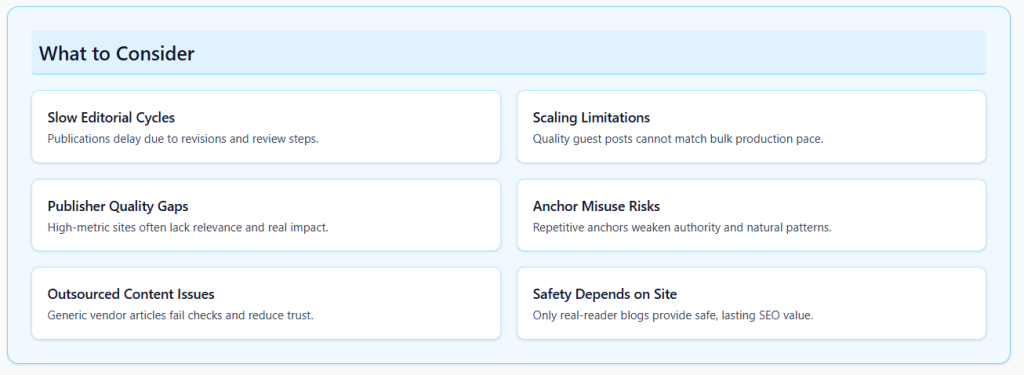
- Editorial cycles are slow. Even paid placements often require multiple revisions, which delays publication.
- Scaling is limited. High-quality articles for reputable blogs cannot be produced at the same pace as bulk link-building content.
- Quality varies across publishers. Sites with inflated metrics but weak topical relevance usually produce low-impact placements.
- Anchor misuse is common. Repeating the same landing page or anchor text across multiple articles weakens the link profile.
- Outsourced content can become a liability. Vendors who lack subject expertise often generate generic articles that fail editorial checks.
- Safety depends on the site type. Leaders often ask, “Is guest posting safe in SEO?” And the answer is “yes” only when the publication has real readers and stable organic visibility.
When Guest Blogging Is Not a Good Fit
- A company needs fast link velocity or short-term ranking gains. Guest blogging is slow by design.
- The niche offers no meaningful expertise to contribute, making every article feel forced or promotional.
- The business seeks large monthly volumes. Guest blogging is a selective, quality-first approach, not a scale-first pipeline.
- The available budget is small, but expectations include Tier-1 or Tier-2 publications.
- Internal reviewers cannot support an approval workflow. Editors expect clarity, accuracy, and quick responses.
- The team is unwilling to invest in credible content. Without strong material, the method loses most of its value.
- Companies question long-term relevance and ask, “Is guest article posting still good for SEO?” while expecting outcomes without editorial discipline or topic fit.
Conclusion
Leaders should view guest blogging as a strategic complement, not a universal fix. It works best when priority pages are defined, messaging is clear, and the business has something credible to say. A structured 12-month plan with target domains, publication cadence, budget limits, and performance metrics makes the channel predictable. When used correctly, guest blogging becomes a stable source of trust signals, referral traffic, and gradual ranking improvements. That combination is what turns it into a practical, long-term SEO asset rather than an experiment.
 ChatGPT
 Perplexity
 Claude
 Google AI Mode
 Grok
Grok