Sign Up


But there is an important nuance here: links may not work. And not just “not work,” but even cause harm.
Why Backlinks Lose Effectiveness
The reasons for this are almost always systemic:
- Low quality of donors. Sites with no traffic, with a spammed link profile, and zero topical relevance do not pass value — they pass risk.
- An unnatural link profile. When 80% of the links are commercial anchors like “buy,” “price,” “order,” search engines interpret this as manipulation.
- Absence of a link strategy. Links are purchased chaotically, without understanding why exactly this link is needed, what result it should produce, and how it fits into the overall profile.
- Algorithm changes. What worked 3–5 years ago (mass directories, articles on exchanges, low-quality PBNs) now either has no effect or leads to penalties.
According to Google, since the launch of the Penguin algorithm, more than 65% of sites using manipulative links have experienced a drop in rankings, temporary or permanent.
What Do Competitors Have to Do with This?
Now, the main question: How do you understand which links work right now in your niche? The answer is simple — look at those who are already at the top.
Imagine that you are participating in a car race. You can experiment with engine settings for a long time, or you can open the hood of the race leader and see what exactly gives them the advantage. Competitor link analysis is exactly such a “hood.”
What Competitor Backlinks Analysis Really Gives
Competitors backlink analysis is the foundation of digital marketing. Any strong strategy is built on the balance of two things:
- Studying best practices
- Your own hypotheses
But being a pioneer is always more expensive. These are dozens of tests, hypotheses, unsuccessful placements, and wasted budgets. Competitive backlink analysis allows you to shorten this path many times over, literally learning from other people’s victories and other people’s mistakes.
And here, it is important to make a key caveat. Competitor backlink audit is not “copy everything and repeat it one-to-one.” This approach often ends with an over-optimized anchor list, trash platforms, and penalties for an unnatural profile.
Proper analysis is:
- To understand the logic of the strategy;
- To see which types of links really give growth;
- To separate strong decisions from accidental ones;
- To adapt all of this to your own project.
Simply put, competitors show you not “what to do,” but where the gold lies in your niche. And you decide how to mine it.
A Step-by-Step Guide on How To Find Your Competitors’ Backlinks and Use Them in Your Work
Step 1. Determine who is really your competitor in search
The first stage is to take a list of business competitors from the sales/marketing department. But in SEO, this does not work that way. We are interested in competitors in search results, not in the market as a whole.
What we do:
- Take 10–20 keywords by which you want to rank. These should include high-frequency (for example, “buy office furniture”), medium-frequency (“ergonomic office chair”), and low-frequency (“gamer chair with neck support”).
- Enter them into Google manually or via a competitor backlinks tool (for example, Ahrefs/Semrush/Serpstat).
- Write down the domains that regularly appear in the top 10 for a large number of your keywords and belong to the same business model as yours (online stores, SaaS, blog, marketplace, etc.). Usually, it is enough to collect 3–5 domains for in-depth analysis of competitors’ backlinks.
Step 2. Check your competitors’ backlinks and collect a database
Now, you need to extract all external links that lead to your selected sites. For this, you can use any competitor backlink analysis tools convenient for you: Ahrefs (Backlink profile → Backlinks / Referring domains), Semrush (Backlink Analytics), Serpstat, Majestic, SE Ranking, MegaIndex, etc.
What we do in practice:
- Enter the competitor’s domain. Go to the Referring domains section — the list of domains, Backlinks — the list of specific links (URL → URL).
- Export the data to Excel/Google Sheets. It is advisable to use the following fields: referring domain, donor URL, acceptor URL (competitor’s page), anchor, link type (dofollow/nofollow/UGC/sponsored), DR/DA/trust, domain/page traffic, topic/category (if available).
Step 3. Clean and group the data
The raw export is chaos: technical duplicates, trash, meaningless pages. We need to turn it into an array suitable for competitor backlink analysis.
To simplify the task, even before export, we use filters in the selected tool:
- Leave only active links (Exclude lost).
- Filter by DR/DA, for example: DR ≥ 10–20 (for small niches, it can be lower), unique domains.
- Discard obvious trash: spam domains (adult, casino, pharma, etc., if this is not your niche), technical subdomains (mail., cpanel., webmail., etc.).
After exporting the dataset, we perform grouping in an Excel/Sheets table. We combine links by domains, and then count how many links come from one domain, to which competitor pages the most links go, and which anchors are used most often.
Step 4. Analyze donors: who really provides value
Not every link gives a boost to rankings. We are interested in donors that really strengthen the site, and not just create noise.
What we look at:
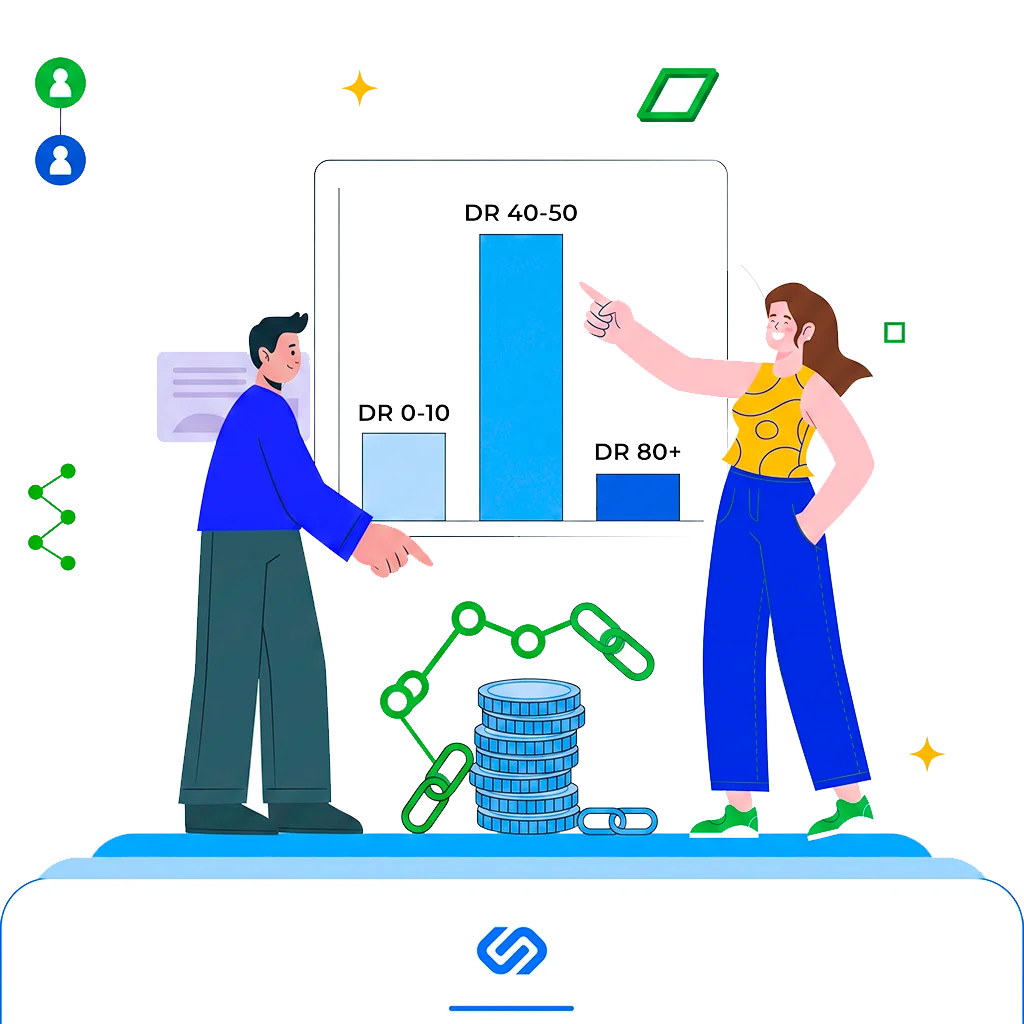
- Domain trust/authority. In different services, this metric may be displayed differently (DR (if you find competitor backlinks with Ahrefs), Authority Score (Semrush), TF/CF (Majestic)). The priority indicator is DR above 30. But this value is quite conditional and strongly depends on the niche.
- Domain and page traffic. We find out whether there is organic traffic at all, and whether it goes to the page from which the link is placed.
- Topical relevance. The site or section should match the topic. For example, in the case of office chairs, these can be interior blogs, e-commerce, product reviews, B2B magazines.
- Type of platform. Many options are possible here: media, industry portals, blogs, catalogs or directories, forums and Q&A, reviews, ratings, collections, guest posts.
Step 5. Break down the context of competitors’ backlinks
Now, the most interesting part: how competitors managed to get placements on these sites.
What we look at for each valuable link:
- Content format. Most often, this will be a review (for example, “Top 10 office chairs”), an article featuring the competitor as an expert, an interview, a case study, a product launch news item, a guest post, or a user review.
- Link placement. The best option is to place it within the body of the article. Competitors’ backlinks can also be located in the footer, in a sidebar block, or in a “Partners” section.
- Anchor. It can be branded (with a mention of the brand), a combination of brand + keyword, a pure keyword (“office chairs”), a URL, or a diluted one (“details on the website,” etc.).
- Target page. Common options: homepage, catalog category, specific product, content article.
Step 6. Look for recurring patterns
When you have reviewed 30–100 strong competitors’ backlinks, patterns begin to emerge.
The patterns we are interested in:
- Types of platforms that appear most frequently;
- Content formats;
- Pages that most often receive links;
- Anchor strategy (distribution of branded, commercial, and other anchors).
Step 7. Form a list of “targets” for your own link building
Now, we translate the analysis into action: we create a working list of sites and formats that we will work with. In the table, for each donor, we record the Domain, DR/traffic, topic, platform type, the format in which the competitor appears, the contact or communication method, and a comment: what we can offer.
Each platform requires its own approach. For example, for media and industry portals, we can offer analytical material with our data, a product implementation case, and expert opinion with figures. For catalogs or ratings, we can provide up-to-date company information, cases, reviews.
Step 8. Build a strategy and a roadmap
Based on the entire analysis of competitors’ backlinks and your own link profile, we form a plan for 3–6 months.
Example of an “action map”
Goal: reach the top 3 for the keywords “office chairs [region]” in 6–9 months.
To achieve this, it is necessary to:
- increase the number of donors from 60 to 150;
- obtain at least 20–30 links with DR 40+;
- ensure 30–40 links to content articles;
- gain presence on 10–15 industry platforms where competitors already exist.
Action plan
Month 1
- Preparation of 3–5 strong informational articles for link building;
- Outreach to 10–15 donors (catalogs, blogs, communities).
Month 2
- Work with industry media: 3–5 case studies/expert materials;
- Guest posts on 5–7 blogs.
Month 3
- Participation in collections/ratings;
- Consolidation on forums/communities;
- Analysis of dynamics: which types of links have already begun to produce an effect.
Step 9. Regular review and additional analysis
The market does not stand still, so it is recommended to spy competitors backlinks once every 1–3 months and track which new formats they are testing. If necessary, you should adjust your strategy.
Over time, you may stop simply “catching up” with competitors and begin to outpace them, especially if you spot new trends earlier, combine successful approaches of different players, and build your own unique link ecosystem.
Conclusion
Backlinks still remain one of the strongest ranking factors in search engines. But in 2025, it is no longer enough to simply “build up link mass.” Today, the winner is the one who builds a smart, manageable strategy based on data rather than guesses.
The most common mistake is to mechanically replicate competitors’ backlinks strategy. This approach rarely produces a stable result and often leads to problems.
The real power of analysis lies elsewhere: you understand why exactly these links work, which formats truly strengthen sites, which sources Google considers trustworthy, and how to adapt these models to your own project.
 ChatGPT
 Perplexity
 Claude
 Google AI Mode
 Grok
Grok