Sign Up

What Are Google Backlinks Today?
Google uses backlinks for two separate purposes:
- Discovering pages
- Evaluating their usefulness.
These processes overlap, but not always. A search engine may find a backlink but choose not to count it. This is a common misunderstanding among beginners.
So, what are Google backlinks in 2025? They are external references that help Google interpret relationships between topics, entities, and user needs. A backlink is valuable only when it improves Google’s confidence about why your page exists and who it helps.
A niche article with a strong topical fit can outperform dozens of irrelevant mentions. In practice, backlinks in Google act more like signals of alignment than signals of fame. Counting them is far less useful than reading their intent and surrounding context.
How Google Evaluates Backlinks Now
Evaluation is multi-layered. It no longer treats backlinks as a simple ranking metric. Instead, the system looks at:
- Relevance. A link must connect meaningful topics. When the linking page serves the same audience or addresses a related problem, Google sees that connection as trustworthy.
- Editorial Intent. Links placed voluntarily matter. Adding them artificially or pushing them into templated locations rarely helps. Google recognizes “editorial choice” as one of the strongest positive signals.
- Page Quality & E-E-A-T. If the linking page lacks expertise or credibility, its recommendations carry little weight. Systems evaluate whether a page shows real knowledge or merely aggregates text.
- Natural Patterns. Link bursts, repetitive anchors, and unrelated domains are filtered or devalued. Google’s systems often neutralize manipulative tactics before rankings change.
- Human Guidance (Google’s own messaging). A cornerstone idea comes from multiple statements made by Google spokespeople:
“Don’t focus so much on the number of links.” — John Mueller, Google
Quantity metrics rarely reflect what truly improves a website.
This reminder is crucial. Chasing backlink totals distracts from meaningful improvements. Modern systems reward value, not volume.
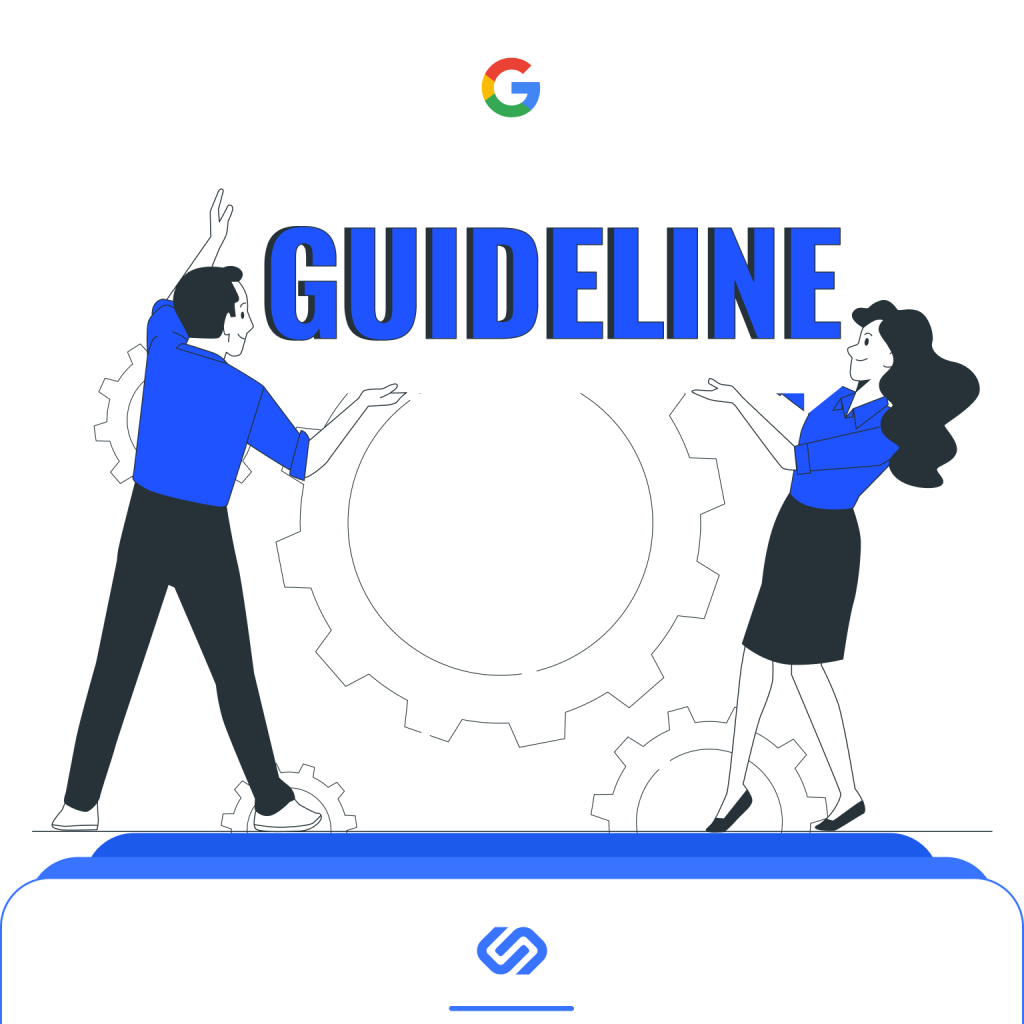
Google’s Official Guidelines for Link Building
The safest compass for any business is the official policy set. Google’s rules define how to build links without crossing into manipulation.
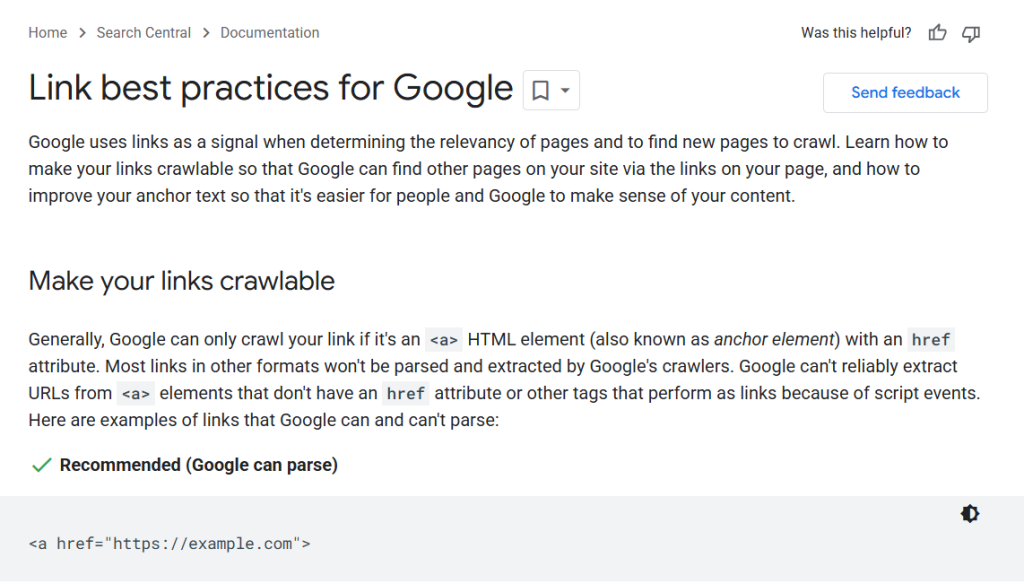
Here are expectations:
- Links must be crawlable.
- Anchor text should be descriptive and natural.
- Paid links must use rel=”nofollow” or rel=”sponsored”.
- Large-scale guest posting, exchanges, and automated schemes fall under spam policies.
Compliance prevents costly ranking issues.
“Use words people would naturally use to find your content.” — Google Search Essentials
This guidance ties directly to Google backlink guidelines, which require clear intent, transparent attribution, and avoidance of coercive link placement.
Types of Links Google Values (and Mostly Ignores)
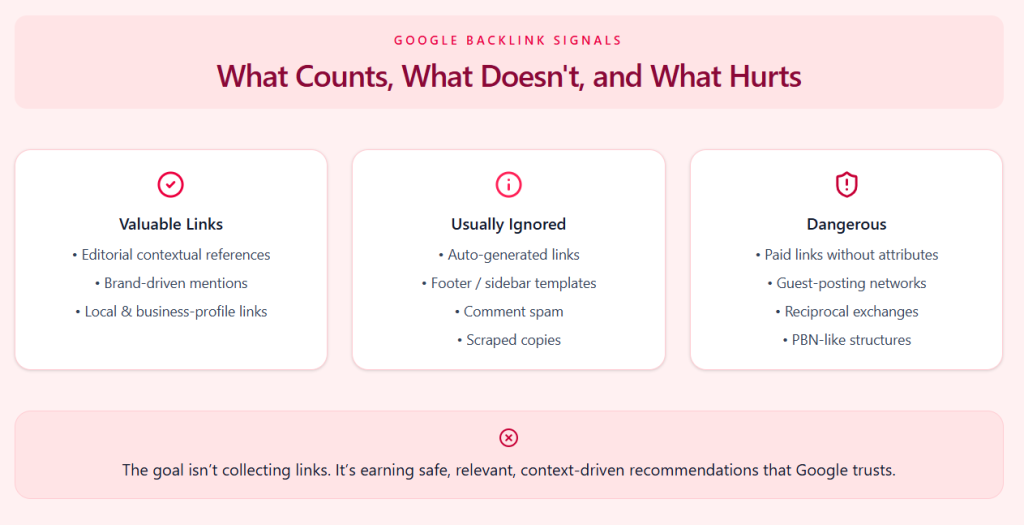
The search engine’s internal filtering is aggressive. Many backlinks never influence your rankings at all. Below is a concise breakdown of what matters and what doesn’t.
Valuable link types:
- Editorial contextual links. These appear when writers genuinely reference your content. They remain the strongest form of authority signal.
- Brand-driven mentions. Backlinks from industry partners, associations, interviews, and directories — when relevant — reinforce legitimacy.
- Local or business-profile links. High-quality, location-relevant mentions support local SEO (e.g., business associations, chambers of commerce).
Links Google usually ignores:
- Auto-generated links;
- Template footer or sidebar links;
- Blog comment spam;
- Scraped content reproductions.
These backlinks exist, but they rarely count.
Links that can be dangerous:
- Paid placements without attributes;
- Aggressive guest-posting networks;
- Reciprocal schemes;
- PBN-type structures.
Businesses pursuing how to get Google backlinks safely must avoid these categories entirely.
The goal is not to “collect more links.” The goal is to earn meaningful, safe, contextually aligned recommendations. When businesses aim for relevance and quality, they naturally get backlinks that Google considers credible.
How to Get Backlinks (Practical Methods)
Acquiring safe links requires intentional, policy-aligned methods, not shortcuts. System rewards helpful content and dismisses artificial patterns. Below are the most reliable approaches.
- Create content that earns references — in-depth guides, data studies, comparisons, industry insights. People link to content that clarifies a topic or answers real questions.
- Provide expert commentary. Journalists and bloggers cite businesses that contribute meaningful insights. This produces clean, high-trust placements aligned with how to get backlink from Google through legitimate visibility.
- Build partnerships. Case studies, collaborations, and interviews often generate natural mentions.
- Use targeted guest contributions. Guest posting is still viable when done with strict relevance and genuine expertise. No mass submissions. No templates.
Google My Business, Brand Assets, and Indirect Backlinks
Google does not actively create backlinks for websites, yet several surfaces influence discovery and trust. These signals may not pass PageRank directly. But they help users and crawlers understand your brand. That’s why many local businesses rely on Google My Business backlinks to strengthen their presence in local search.
Google Business Profile (GBP)
Your GBP listing can include several types of links — a website link, an appointment URL, product URLs, and even links placed inside Google Posts. None of them acts as a classic ranking booster. They influence local visibility in a different way. Search engines rely on Business Profile data to form a clear picture of your company — who you are, what you provide, and which local needs you serve. This context shapes how your brand appears in local results. The website link inside your GBP panel strengthens that understanding. It gives Google a direct, trusted pathway to your site, and it removes ambiguity about your primary online presence.
Google-owned content assets
YouTube descriptions, Google Sites, and public Docs can contain outbound links. These are sometimes discussed as Google site backlinks, but they work differently from editorial mentions. Their value lies in brand validation, crawl paths, and supplementary context rather than classical link authority.
Discovery benefits
When your brand appears across multiple properties, crawlers build a clearer map of entity relationships. It’s not a “ranking hack,” but it improves coherence. For many smaller companies, this coherence makes their expertise easier for algorithms to interpret. Consistency matters more than volume.
What businesses should do
- Fill out the entire Business Profile.
- Add products, services, appointment URLs, and posts.
- Maintain consistent NAP (Name–Address–Phone).
- Use YouTube or Google Sites as content extensions when relevant.
Indirect signals cannot replace genuine, earned mentions. But they give support. They provide a stable baseline for broader authority.
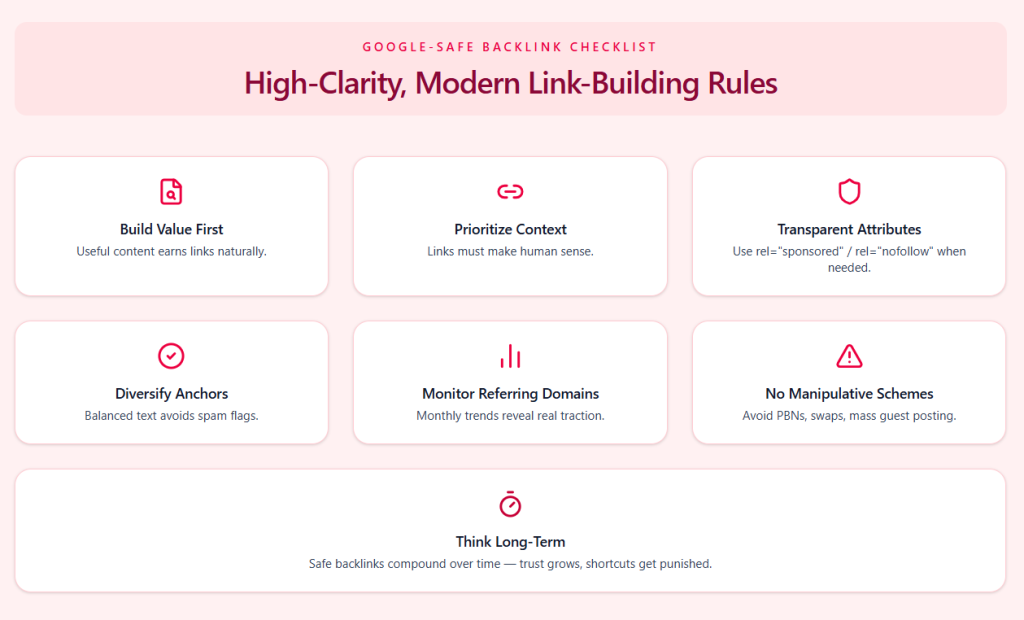
Practical Checklist for Google-Compliant Link Building
Below is a high-clarity checklist designed for founders, marketers, and consultants. It reflects current policies and the modern landscape of Google SEO backlinks.
- Build value before asking for links. Backlinks follow usefulness. If the content is thin, outreach barely works. High-quality articles earn attention, even in small niches.
- Prioritize context and relevance. Ask a simple question: Would a human click this link? If not, the system probably won’t value it.
- Maintain transparent attributes. Use rel=”sponsored” or rel=”nofollow” when compensation is involved. Transparency is non-negotiable.
- Diversify anchor text. Balanced anchors reduce spam signals. Avoid keyword-stuffing or repetitive formulas.
- Track referring domains monthly. Monitor new mentions and lost links. Look for patterns that reflect real engagement.
- Avoid manipulative exchanges. Large-scale swaps, PBNs, and automated link marketplaces fall under spam policies. The search engine ignores or penalizes them.
- Think long-term. Safe link building is not a “fast win.” It scales gradually, building trust rather than noise.
This checklist aligns naturally with the philosophy behind Google link building. It rewards clarity. It rewards honesty. And it punishes anything that looks like a shortcut. Search engines have no patience for manipulation, but they consistently reward genuine usefulness.
Key Takeaways for Business Owners
Businesses succeed when they treat links as outcomes, not as tactics. Relevance matters more than volume. Transparency matters more than clever tricks. Google responds to signals that genuinely help users, not to engineered patterns designed to “look authoritative.”
Strong content builds momentum. Credible mentions amplify it. Safe link-building is slow at first, but it compounds — and unlike risky schemes, it never collapses under algorithm updates.Whether your strategy centers on Google SEO backlinks, brand citations, business-profile mentions, or contextual references, the rule is identical. Make something worth citing. A link built for people will outlast any link built for rankings.
 ChatGPT
 Perplexity
 Claude
 Google AI Mode
 Grok
Grok