Sign Up


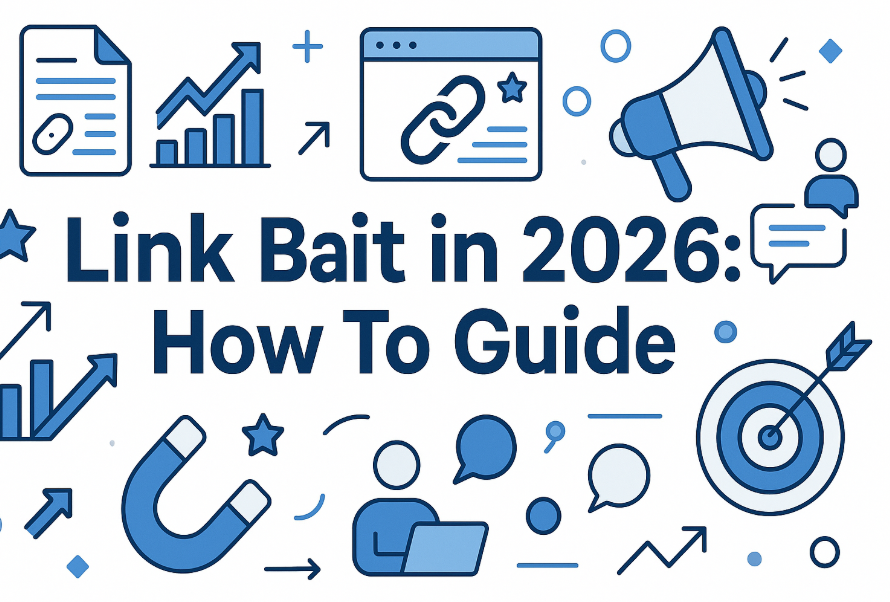
Here, you’ll find a clear definition, an outline of ethical boundaries, key business advantages, the main formats that work today, and practical steps for creating assets that consistently attract links.
What Link Bait Really Means
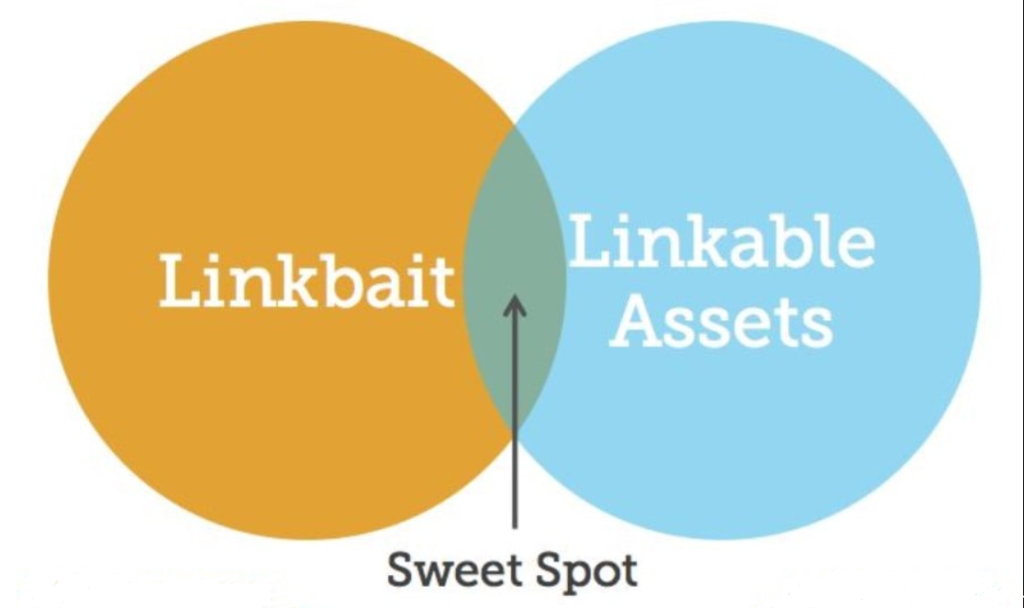
Link bait is content or a digital asset designed to attract backlinks naturally because it offers material that others want to reference. Modern teams use it to create something worth citing rather than pushing content through traditional outreach. Unlike paid placements, these assets earn editorial attention based on usefulness, originality, or data quality. This idea aligns with what is linkbait in current SEO practice: a strategic approach, not a manipulative trick.
Pros and Cons
| Pros | Cons |
| Earns links without direct payment | No guaranteed number of referring domains |
| Builds long-term authority when done well | Requires time, research, and design resources |
| Strengthens brand expertise and credibility | Can underperform if the topic lacks demand |
| Works across PR, SEO, and content | Some formats are easy for competitors to copy |
| Scales over the years with minor updates | Risk of misinterpretation if the data is unclear |
| Supports natural citations from high-authority sites | Distribution still requires effort and planning |
Ethical Considerations
Ethical link bait focuses on providing real value: accurate data, transparent methodology, and insights that genuinely help readers. Manipulative tactics, such as fabricated statistics, misleading comparisons, or sensational claims, create short-term attention but long-term brand damage.
Teams should anchor their work in facts and avoid formats that distort information simply to solicit bait link clicks. A sustainable tactic avoids deception and respects the intent behind what is link baiting as a legitimate SEO and content strategy.
Five Reasons Businesses Choose Link Bait
- Long-term ROI that compounds over time. Link baiting helps teams generate backlinks for months or even years after publication, which makes the cost of production easier to justify. Some assets require only minor updates to stay relevant. This endurance makes link baits more economical than repeated paid placements over long horizons.
- Access to editorial backlinks that cannot be bought. Many respected publications and industry blogs do not accept payments, but they willingly cite strong resources. Link bait in SEO gives brands a path into these higher-authority environments. It strengthens overall domain credibility and supports competitive rankings.
- Stronger alignment with PR and brand positioning. Quality assets generate mentions, quotes, and citations beyond SEO alone. Visuals, data, and expert commentary fit naturally into media coverage, which expands brand visibility. Downstream effects make linkbait examples particularly effective for companies investing in thought leadership.
- Applicability across multiple industries. SaaS, e-commerce, fintech, operations, HR tech, and professional services all benefit from content that solves specific problems or clarifies trends. Teams can adapt formats—tools, research, frameworks—to match their vertical. This flexibility is a major reason executives explore what does link baiting mean in practice.
- Reduced reliance on purchased links. While paid placements still serve tactical needs, linkbaiting reduces dependency by creating a parallel earned-link engine. Many teams use it to stabilize acquisition costs and diversify link-building sources. It allows building healthier backlink profiles and more resilient ranking patterns.
Core Types of Link Bait
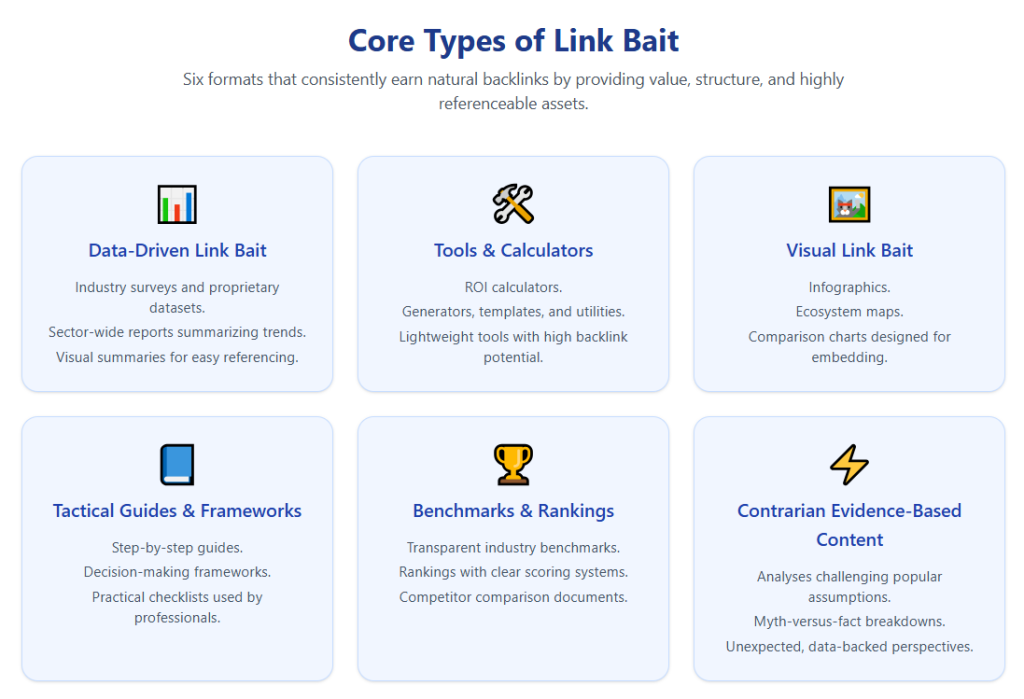
Different types of link bait work for different goals, audiences, and levels of production capacity. The formats below cover the models that consistently earn backlinks across industries because they provide information, tools, or structure that others find worth referencing.
Data-Driven Link Bait
- Industry surveys and proprietary datasets that answer specific questions;
- Sector-wide reports that aggregate trends across markets;
- Visual summaries that make data easier to reference.
These formats often appear in link baiting examples used by high-authority publications.
Tools & Calculators
- ROI calculators that quantify savings or performance;
- Generators, templates, or worksheets that fill immediate user needs;
- Small, lightweight utilities that outperform articles in terms of backlink potential.
Such assets frequently show up in examples of link baiting in B2B content libraries.
Visual Link Bait
- Infographics that condense complex topics into digestible visuals;
- Ecosystem maps showing relationships within an industry;
- Comparison charts designed for quoting and embedding.
These formats offer clarity, which supports link baiting meaning in editorial workflows.
Tactical Guides & Frameworks
- Comprehensive guides that outline a process or solution;
- Compact frameworks that help readers make quick decisions;
- Practical checklists used in niche professional workflows.
This category works well when teams demonstrate how to do link baiting in SEO without overcomplication.
Benchmarks & Rankings
- Industry benchmarks grounded in transparent data;
- Rankings that follow a clear scoring system;
- Competitive comparisons that help decision-makers evaluate tools or vendors.
Rankings remain one of the strongest link bait examples when produced responsibly.
Contrarian Evidence-Based Content
- Analyses that challenge popular assumptions with credible data;
- Myth-versus-fact breakdowns supported by research;
- Position pieces reframed through a non-obvious angle.
These assets often gain traction because they introduce fresh context to linkbaiting-heavy markets.
Top 10 Tips for Effective Link Bait
Before producing link bait, teams benefit from a clear set of operating principles that keep the process focused and predictable. The following practices help ensure that each asset has a realistic chance of earning backlinks rather than relying on guesswork:
- Validate demand by reviewing linkbaiting patterns among competitors and noting what earns consistent citations.
- Choose formats that match realistic production capacity and avoid unnecessary complexity.
- Build assets around first-party data whenever possible to increase authority.
- Create visual components that journalists can embed with minimal editing.
- Use a straightforward structure so readers can extract key insights quickly.
- Prioritize distribution as much as production; both determine results.
- Update assets annually to maintain accuracy, especially if they rely on numbers.
- Ensure every claim is verifiable to avoid reputational risk and weak bait links.
- Keep the design clean and simple to avoid distracting from the core value.
- Benchmark performance by tracking link baiting techniques that consistently outperform others.
Conclusion
Effective link bait creates genuine value, earns editorial credibility, and reduces dependence on paid placements. It works when teams combine strong research, thoughtful design, and a disciplined distribution process. Companies use linkbait to strengthen authority, expand visibility, and build assets that continue attracting backlinks over time. While results are never guaranteed, disciplined execution produces stable long-term benefits. When applied responsibly, link baiting assets become an integral part of a broader acquisition strategy, supporting SEO and brand visibility across markets.
 ChatGPT
 Perplexity
 Claude
 Google AI Mode
 Grok
Grok